A clearer cup without plunging
A settling method for a less silty French press.
4 minute read, Chapter 02, lesson 3 of 5
This French press method, popularised by James Hoffmann, lets particles settle before serving. It takes longer than the basic press routine and uses the mesh near the surface rather than plunging to the bottom.
Start with a measured brew
Use a measured recipe such as 30 g coffee and 500 g hot water. Try medium to medium-coarse grounds. Wet them evenly and steep for about four minutes.
Break the crust and wait
Gently break the floating crust with a spoon. Skim floating grounds if you wish. Leave the brewer still for another five minutes or so. The coffee keeps extracting and cooling while particles settle.
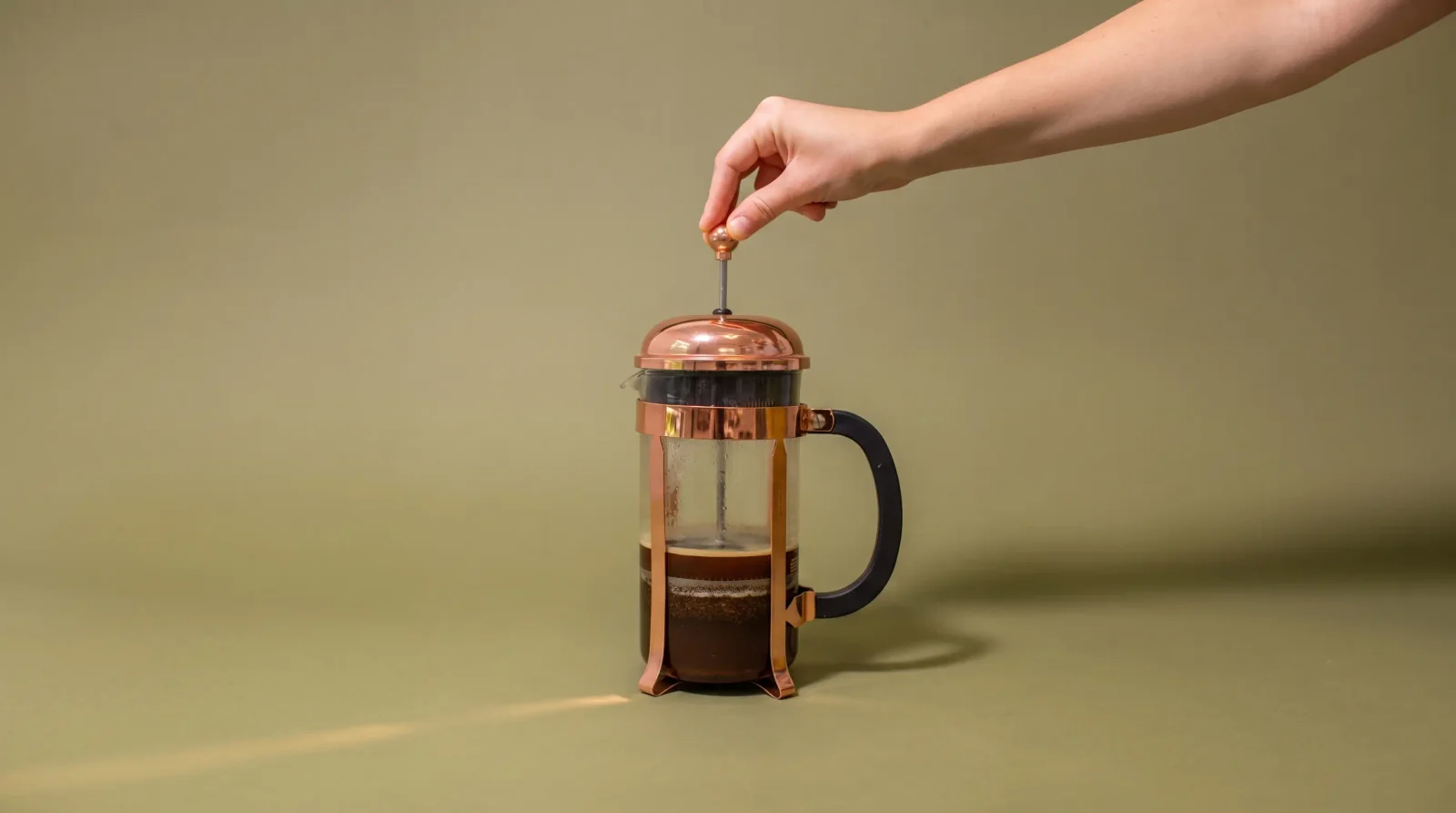
After the first four-minute steep, break the crust and wait about five more minutes. The total wait is roughly nine minutes from the first water. Then use the mesh as a surface strainer. This is a serving method, not a new coffee-to-water ratio.
Surface-strain and pour
Lower the mesh only to the liquid surface. Pour slowly through it and leave the silty last portion behind. Keep the brewer stable and your hand away from hot glass.
Comparing an immediate plunge with a later surface pour changes both waiting time and mesh movement. To investigate the mesh alone, use the same waiting time for both brews and change only how you serve.
What the wait changes
The extra wait helps texture; it is not an extraction off switch. The mesh still allows some small particles through, so this is not the same as paper filtration.
- Full plunge. Moves the mesh down through the liquid and grounds.
- Surface strain. Keeps settled grounds quieter while pouring carefully.
Interactive
Try this lesson in the Pourrr app.
In the app, this lesson comes with interactive visuals and a quick check.
Available in India on iOS and Android, with more countries to follow.


Available now on iOS and Android.
Compare serving methods
Compare this routine with your usual press. Taste both at a similar comfortable temperature. Note whether the clearer texture is worth the extra waiting time to you.
- Keep the same inputs. Use your familiar dose, water and grind.
- Allow the extra wait. Separate lesson time from the longer brew routine.
- Compare texture. Taste beside your normal press routine.
Look at the sediment left in the press and at the bottom of the cup. Did the gentler serving reduce grit? Did the flavour change too? Keep whichever routine fits your preference and available time.
In one lineLet the grounds settle, then pour gently through the mesh at the surface.
Practise it
RecipeTotal time
French press Hoffmann no-plunge
A longer settling routine. Strain at the surface and leave sediment behind.
Brew the lesson recipe