Use your kettle well
Kettle settings, preheating and heat loss during brewing.
4 minute read, Chapter 04, lesson 4 of 5
A kettle setting describes water in the kettle. It is not a constant temperature around every coffee particle once brewing begins.
Heat loss during brewing
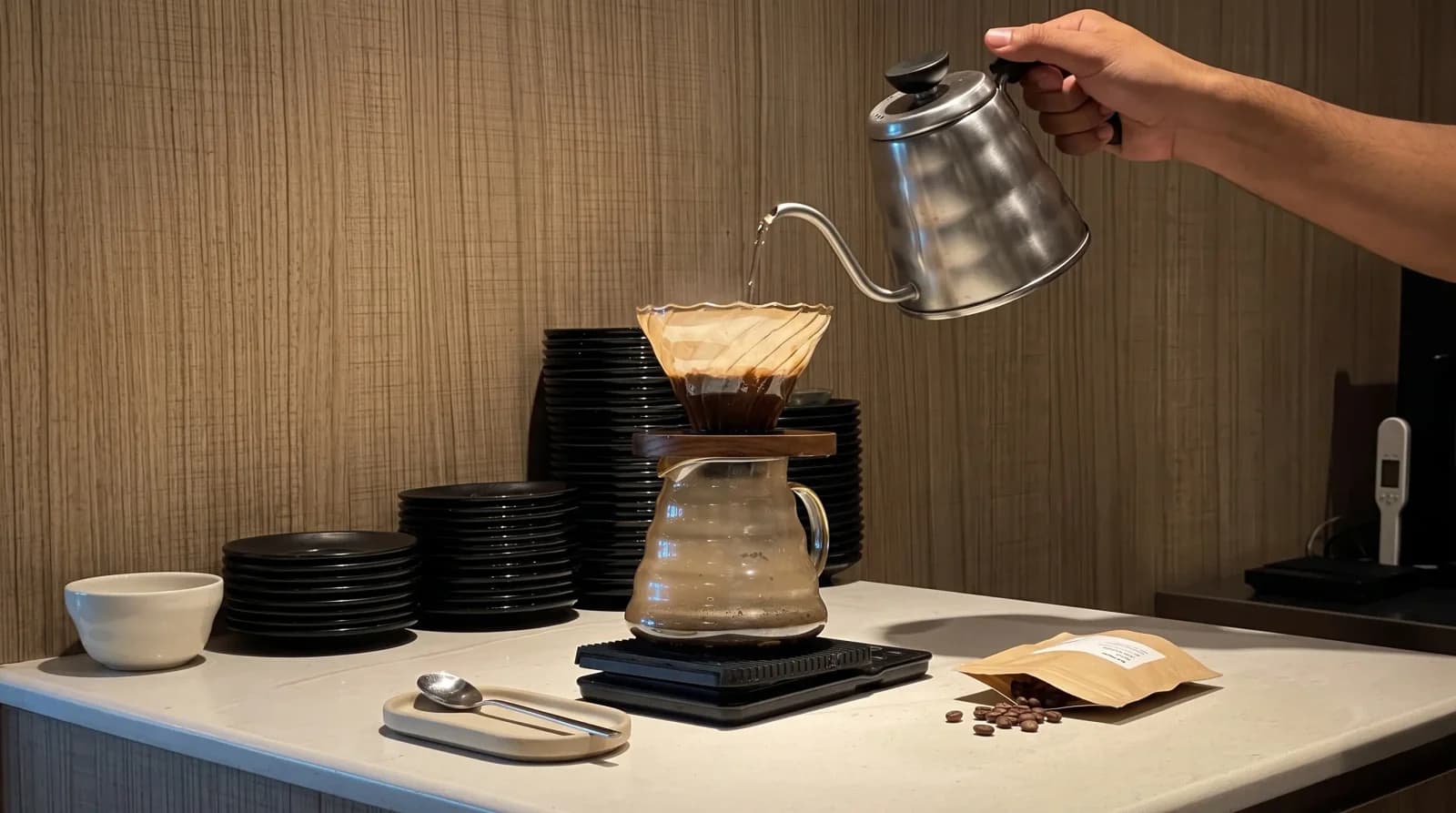
Water loses heat while pouring and while warming the brewer and coffee. Repeat kettle fill level, preheating and pouring so temperature comparisons mean something.
When to preheat
Preheat heat-safe equipment when cooling is a problem, then discard the rinse water. A heavy cold dripper can absorb more heat than a light one. Follow the maker’s heat limits.
If you pour 94 °C water into a cold glass brewer, the brewing liquid may be cooler than 94 °C. Pouring the same water into a preheated brewer can change that cooling. The useful comparison keeps the dose, grind and pour pattern the same.
Boiling at elevation
At higher elevations, water boils below 100 °C. Use local boiling as a repeatable reference rather than chasing an impossible setting. If needed, compare grind or contact time by taste.
A fixed waiting time after boiling does not give every kettle the same temperature. Water quantity, vessel material, room conditions and altitude all affect the result. Do not assume “wait thirty seconds” means one exact number.
Repeat a safe routine
A kettle without a display can still make good coffee. A consistent sequence is useful: the same fill, boil, wait and pour. Keep steam and hot water away from your hands.
Interactive
Try this lesson in the Pourrr app.
In the app, this lesson comes with interactive visuals and a quick check.
Available in India on iOS and Android, with more countries to follow.


Available now on iOS and Android.
Compare preheating
Compare your usual brew with and without preheating, changing nothing else. Taste at a comfortable temperature. Keep the routine that works for your equipment.
- Pick one sequence. Record how you heat, wait and pour.
- Keep the vessel routine. Preheat and discard rinse water consistently.
- Taste a controlled comparison. Change temperature only when you have a reason.
Record the kettle setting or boil-and-wait routine, fill level and preheat step. Can you repeat them easily? Did preheating produce a clear taste improvement or mainly add effort?
In one lineRecord a repeatable kettle and preheating routine, not just a temperature number.
Practise it
RecipeTotal time
V60 Hoffmann ultimate
The original Ultimate V60: bloom, then a continuous main pour in two stages.
Brew the lesson recipe